Blog of John Spencer: UK Personal Injury Solicitor
John is one of the UK's leading personal injury solicitors, with over 28 years of experience. In addition to his role as Director of Spencers Solicitors, he is an advocate for claimant rights and believes that wholesale reform to the personal injury arena is needed to ensure transparency, access to justice and the protection of injured people. In this blog, John writes regularly about these issues.
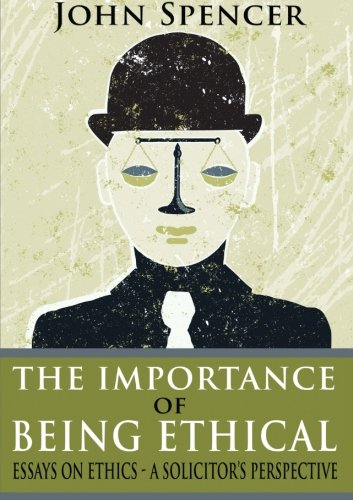
I was prompted to put pen to paper because of what I've seen happening in the personal injury sector and society at large. My premise is a simple one: our society is rife with unethical conduct, and it occurs to the detriment of everyone.
In the personal injury arena, we've seen all manner of shoddy practices in recent years, from referral fees and backhanders to cynical insurer-driven spin to the effect that we are plagued by a 'compensation culture' (a palpable myth) and that whiplash, a painful and debilitating condition, doesn't exist. These things have exercised me but so too have wider societal problems.
For example, as we sit down to watch - or avoid - the latest series of The Apprentice, can we really believe that its contestants and their greed-driven egos are a good thing? In sport, why do we continue to condone cheating, as if the player who 'takes one for the team' is a shining exemplar of how to behave? In politics, the Nolan Principles, which put a premium on selflessness in the interest of the public good, are too often AWOL, as is also the case when it comes to ethics in the worlds of big business, banking, the media and police conduct.
But for all that the latest outrage inevitably prompts calls for a new set of laws, we rarely need them. As is illustrated by the phone hacking scandal, a raft of perfectly sound laws exist to criminalise rogue journalists' behaviour; their lack of ethical scruple meant that they chose to ignore the law.
"Integrity has no need of rules", said the French writer Albert Camus. He is right. We don't need a barrage of extra red tape but we do need a re-commitment to behaving ethically.
I hope that The Importance of Being Ethical prompts, in some small way, a re-engagement with doing the right thing.
Hats off to Germany. They were the best side throughout the World Cup, and deservedly won what has to have been one of the best tournaments to date. There were some extraordinary games in Brazil between 12 June and 13 July, not least the eventual winners 7-1 thrashing of the hosts. Other classics were Nigeria 2, Argentina 3 and Germany 2, Ghana 2, though of the England team, perhaps the best thing to do is say that young players like Raheem Sterling and Daniel Sturridge showed that we might just have a decent future.
But if Brazil 2014 will go down in history as a great and memorable World Cup, it could have been etched in our minds for the wrong reason. I refer not to what might have happened if Luis Suarez had longer teeth, but to the scant understand shown by match officials and administrators of the dangers of head injuries.
Potentially terrible consequences
Three serious incidents occurred in Brazil which could have had terrible consequences for the players involved. The first came when Uruguay beat England 2-1. Álvaro Pereira, the Uruguay defender, was knocked out in a collision with Sterling's knee. As The Times reported: "The Uruguay medical team were seen calling for his substitution, only to be overruled by the player, underlying their helplessness as occupational health physicians."
Next came Argentina's semi-final win over Holland. The superb Javier Mascherano clashed heads with Georginio Wijnaldum towards the half hour mark and showed clear signs of concussion, wobbling on his feet before slumping to the pitch. In spite this, he was allowed to play on.
Then came perhaps the worst incident of all, played out for all the world to see in the final. Christoph Kramer found himself in Germany's starting line-up (making his competitive debut for his country) after an injury in the warm-up to midfielder Sami Khedira. Early into the game, the young player's head smashed accidentally into an Argentinian player. Kramer was visibly disorientated, but was allowed to play on by Germany's medical staff. Fourteen minutes later, he fell to the ground, and was then substituted.
Boorish Lawrenson
Kramer has subsequently said that he couldn't remember anything of the first half the game. He looked awful as he left the pitch, eyes glazed and with a look of 'where am I and what is happening?' etched all over his features. His departure made for a telling counterpoint to the boorish, old-school tough guy commentary of the BBC's Mark Lawrenson, who was persistently sarcastic at players' injuries throughout the tournament and objected to the Argentinian players calling - sportingly - for the ball to be put out of play when Kramer lay stricken. Lawrenson further demonstrated an apparent ignorance of what happens with head injuries when saying, as Kramer groggily waited to come back on, "He's fine. He's jogging round the pitch now."
Thankfully, albeit that he was taken off looking anything but fine just under quarter of an hour later, Kramer does seem to be fine. So, too, was Tottenham goalkeeper Hugo Lloris, despite playing on after a head injury last November. Likewise, we hope, Pereira and Mascherano.
But here's the rub: when it comes to head injuries, we just don't know what damage may have been done. And a minute or two of pitchside assessment, when a player has been knocked out or is as visibly awry as Kramer, is woefully inadequate.
Fifpro, the world players' union, has rightly criticised Fifa for failing to protect the players upon which its tournament depends. The union predicts "a tidal wave [of compensation claims] that will engulf" professional football, unless a protocol regarding concussion is adopted as part of the rules of the game. Radically, and yet sensibly, Fifpro also calls for a review of the laws of the game to compensate a team if it goes down to 10 men while a head injury is being assessed.
Prevention is better than cure
And assessment is crucial. We don't want professional football to end up like the NFL in the United States, or the NHL, where significant class action litigation over head injuries is now a fact of life. Not because of bogus objections to people suing for compensation, but because we don't want to see people needlessly injured. The fact is that a head injury can be fatal; it can lead to Second Impact Syndrome, when a later blow on top of the first one leads to brain damage or death.
Proper attention to head injuries is vital. It is essential that Fifa and the game's national governing bodies around the world take action to ensure that prevention is better than cure - for the fundamental reason that when it comes to a head injury, there may well not be a cure.
Let's give thanks to the continuing recovery of Christoph Kramer and his colleagues - and pray that a professional football match is not one day the scene of a fatal head injury because of governing body negligence.
Turning 40 isn't always a welcome event. We tend to lament the formal entry into middle age and, in some cases, deal with it in a curious way - perhaps going and buying a Harley Davidson motorbike, or setting off to climb Mont Blanc. Some of us even deny that turning 40 has happened.
But this year, a 40th anniversary should be applauded and publicised as much as possible. Granted, it's not a human one. I'm referring, though, to something created by human beings and made into the law of the land: the Health and Safety at Work Act, 1974.
The Act received the Royal Assent on 31 July 1974. For all that the redtops insist on running stories bemoaning the 'nanny state' and claiming that it's a result of this piece of legislation, they're wrong. The Health and Safety at Work Act has changed our lives immeasurably for the better.
Before the Act came into being, fatalities to employees covered by the legislation then in place stood at 651. Hundreds of thousands of people were being injured. But last year, as this piece from the Telegraph reports, the number of fatalities at work was down to 148 and non-fatal injuries have dropped by more than 75 per cent. This is a result of the Act and, indeed, the actual reduction may well be greater: back in the early seventies, data for sectors not covered by health and safety law was not collated.
A Duty for all employers
The Act places a duty on all employers 'to ensure, so far as is reasonably practicable, the health, safety and welfare at work' of all their employees. Among its provisions, the Act requires employers to ensure the safe operation and maintenance of the working environment, plant and systems; the maintenance of safe access and egress to the workplace; the safe use, handling and storage of dangerous substances; that there is adequate training of staff to ensure health and safety; and that there is adequate welfare provision for staff at work. Safety procedures must be displayed for all to see, proper training given, adequate protective clothing worn and risk assessments made. All risks must be controlled and monitored.
All this is profoundly sensible. Thanks to the law putting these duties on employers it is likely that the Act has reduced deaths by 5,000 or more. Health and Safety Executive Chair Judith Hackitt summed up the effect of the Act well, writing, in January:
"This year will mark 40 years since Health and Safety at Work Act received Royal Assent. Arguably it is one of the best pieces of legislation on the statute books - although we know it is often misunderstood and misinterpreted. It has protected millions of British workers, and driven sharp reductions in incidents of occupational death, serious injury and ill health."
Creation of the Act
The Act came about as the result of the recommendations of the Robens Committee, which reported in 1972. It concluded that the existing workplace safety legislation was too complicated and confusing, with about 30 Acts and 500 sets of regulations. Lord Robens proposed a simplified structure, the primary intention of which was to ensure that the highest standards of health and safety at work were met.
Intriguingly, Lord Robens did not cover himself in glory in 1966, when the Aberfan disaster happened. Then, at 9.15 am on Friday, 21 October 1966, a Welsh community was devastated when a waste tip slid down a mountainside. Colliery waste, liquefied by underground springs, killed 144 people, 116 of whom were children. Lord Robens, then the Chairman of the National Coal Board, took a full 36 hours to arrive at Aberfan, preferring first to attend his investiture as Chancellor of the University of Surrey. Robens' subsequent behaviour over Aberfan was scheming and cynical, as revealed by Professor Iain McLean and Martin Johnes in their excellent book, published in 2000, Aberfan: Government and Disasters.
Perhaps Robens' conscience helped him later urge the enactment of the Health and Safety at Work Act? I am not sure, but I do know that the Act is a 40-year-old that we should celebrate.
This article was first published in the Journal of Personal Injury Law and appears by courtesy of Sweet and Maxwell/Thomson Reuters.
The legal profession has been able to advertise since 1986. What was first a case of crossing the Rubicon for an instinctively conservative profession was quickly embraced and is now widely practised. But the Legal Services and Punishment of Offenders Act 2012 (LASPO) makes it more important than ever to advertise effectively.
This article focuses on digital media and how traditional promotional methods should work in tandem with digital technologies to reach more clients, concluding with an examination of how to monitor and measure the success of work generation strategies.
John Spencer draws on his own experience over the past 30 years, and especially since the autumn of 2011- during which period the author rebuilt his practice from one which depended exclusively on referral fee based sources of work to one which, in 2014, generates 70% of its work directly rather than from referrals.
The legal and professional framework
Since 1986 it has been possible for Personal Injury (PI) practices to advertise, but with the implementation of Legal Aid Sentencing and Punishment of Offenders Act 2012 on April 1, 2013, the necessity to market well and effectively has been brought home with renewed force. Indeed, in today's legal services landscape, to ignore marketing imperatives would be tantamount to commercial suicide. The welter of change to which the PI sector has been subject is as well-known as it is dramatic, involving the introduction of qualified one way costs shifting, the removal of recoverability of success fees and ATE premiums, the increase of 10% in general damages, a greater emphasis on proportionality of costs and the extension of fixed costs, as well as fundamental changes to the court's approach to case management and costs budgeting. Aside from all these factors, arguably it is the ban on referral fees (LASPO ss.56-60) which brings about the greatest challenge for firms having to 'self-generate' work for the first time.
This article does not focus on ways to circumvent the referral fee ban through one of the avenues available, whether by forming an alternative business structure (ABS) or embarking on a joint venture through an ABS, or through arranging for the provision of 'information' which would enable the recipient to provide relevant services to the client through the client him or herself, or indeed through other methods.
Instead, it focuses on how to generate work directly through other marketing techniques. But aside from the referral fee ban, what are the relevant regulatory provisions that practitioners need to have in mind?
In marketing, as in all areas of practice, the 10 mandatory principles in the SRA Code of Conduct are pertinent and form an overarching framework for practitioners. Principles most relevant to marketing are to act with integrity, not to allow independence to be compromised, to act in the best interests of each client and to behave in a way that maintains the trust the public places in the legal profession as a whole.
In addition, practitioners must comply with their legal and regulatory obligations. Outcomes from this part of the Code include ensuring publicity is not misleading, that charges are clearly and unambiguously expressed, and that unsolicited approaches in person or by telephone to publicise practices are avoided.
Taking code compliance as read, how should firms proceed to plan their work generation strategies?
Ethos and focus
Each practice should ensure that it has a clear position, established through focusing first on its clients and developed through engagement with all those working in its business. This will form the backdrop to the practice's business plan generally and specifically its business development plan. Never is it more important to have clarity in positioning than when communicating with the public. An established, clearly defined firm ethos will help establish priorities, for example whether the emphasis is local or national and which categories of injured persons and liability types are in focus (and in what order of priority). The ethos and targets will inform communication and advertising as will ancillary choices such as those with regard to sponsorship.
Existing clients are a goldmine of information. For instance they will inform the importance of reliable ancillary advice and home visits, as well as the sorts of information that injured people would like to be able to access through a firm's website. What questions they have, and in what level of detail they would like answers, can all help identify changes and enhancements to assist clients and potential clients. Clients will also reveal what matters most to them, perhaps the importance of their local community, and other issues which they see as a high priority. Each practice will have different dynamics to consider and will make different choices, but it is vital that there is this kind of engagement with clients. It is an ethical as well as a commercial mistake not to do this.
Traditional media
Traditional media should not be ignored, and the mix of media used will vary according to budget, locality, ethos and preferences. Digital resources simply provide new and more powerful ways of promoting a practice. There is still need to create written articles and comment, engage in conferences and be involved in and known around your community. Just as personal folders in Microsoft Outlook replace paper files, so the internet supplies the foundation for a relatively new and extremely powerful communication tool.
There remains the need have to have something to communicate which is consistent with the chosen ethos and focus and it must be credible. This remains core material for practices which now can reach so many more through digital technologies.
Moving away from referred work means that advertising in all its forms becomes vital. Through newspapers, radio and even TV, each practice will cut its cloth according to its budget taking account of its target audience. Consistency and core values become even more important here to ensure that practices are consistently presented; ideally, nothing should ethically jar.
Digital media
Digital applications are the single most powerful tool with which businesses can communicate today. Referring to IT in his latest book Tomorrow's Lawyers, Richard Susskind states:
"IT is now pervasive in our world. There are over 2.2 billion Internet users … and every two days, according to Google's Eric Schmidt, 'we create as much information as we did from the dawn of civilisation up until 2003'."
Website
The website is the shop window of a practice and it must be right. If the shop window is wrong, people will not visit. The ethos, approach and philosophy need to be accurate and therefore credible and clearly explained. This needs to be consistently presented across all aspects of the website. Services need to be clearly explained, contradictory services should be avoided; if this is not the case there needs to be a focus on something other than service type to avoid contradiction. For example, a practice specialising in both claimant and insurer PI work may have a core value around excellent and fearless professional representation whatever the issue at stake, whereas an exclusively claimant practice can take a more unequivocal claimant-campaigning position if it so chooses. Visitors to sites need to be comfortable with where they have landed, and confident they will be well looked after. Advice needs to be relevant, clear and concise.
Moreover, potential client visitors landing need to be converted to be clients. Technologies like conversion analytics and heat maps to show where visitors tend to focus can help inform where an invitation to provide instructions might be most effective; it will also reveal areas of lesser interest to visitors. To most visitors external accreditations and kite marks are important, as are (perhaps more surprisingly) photographs of premises.
Pay per click
Pay per click is a method of advertising on a search engine when a user types in a certain phrase. But unlike most other forms of advertising payers only pay for the click once someone has interacted with it.
Pay per click became very expensive in the immediate aftermath of the referral fee ban in April 2013.
Prices have settled somewhat but it remains expensive and each enquiry generated through pay per click may cost several hundred pounds or more. Pay per click is a bidding process where quality and price are relevant. If a practice is perceived to be of greater 'quality' it will pay less for a search term. This is another reason for firms to invest time and resource in optimisation in that it will improve its quality rating and consequently reduce the cost of pay per click. To increase scale will also reduce the cost of pay per click. However, I focus on quality in looking at optimisation.
Search Engine Optimisation (SEO)
In the United Kingdom, Google has 88% of the search market, with its closest competitor Bing/Yahoo having around a combined 10% of the rest. In the United States, Google is less dominant, having around 70% of the market. Maximising the impact of a practice through optimisation when people use search engines is important, especially so with Google given its dominant market share.
While pay per click advertising can get services onto Google, the majority of the content on the results page is still made up from organic listings. Organic listings appear on merit and what Google judges to be the most relevant content for what a web user is searching for.
Optimising content to try to rank higher in search-engine owner results, known as Search Engine Optimisation (SEO), is a long-term project, whereas pay per click provides quick and early wins. A practice can also calculate fairly accurately, once its strategy is established, what its pay per click spend will yield in terms of enquiries; this is not so with SEO. SEO is about quality content, and refreshing, reviewing and continually working to improve the number of visitors received. For a successful SEO strategy it is important to engage as many people working in an organisation as possible in the process. There are different challenges with pay per click: it is expensive, and the lower the perceived quality of content the more expensive it is.
There are, however, dangers with SEO and organic listings. Search engines like Google are becoming increasingly strict. They want genuine websites that offer the most value and relevance, and without any manipulation. They regularly develop and change their algorithms (the rules which the search engine uses in order to rank pages), and are making concerted efforts to eradicate manipulation. Constant vigilance is required to avoid falling foul of their policing through optimisation strategies. In essence, optimisation must be genuine rather than seeking to enhance reputation falsely - which is what the search engines are trying to prevent.
Search engine policing
As stated earlier, Google is the overwhelmingly dominant search engine, and for this reason I use it as an example. However, the principles in operation will equally apply to other search engines.
Google monitors approximately 200 signals from web pages when deciding how to rank them in its results. This process is largely done automatically and algorithmically by constantly trawling web pages to determine which is the most relevant to display in relation to users' searches.
In theory, this means that pages which are the most relevant and offer users the most value will rank above those that offer less. Google details its ranking principles in its Webmaster Guidelines which sets out how pages should be built in order to provide users with the best experience.
But as with any rule, there are those who will seek to bend and even break them. For this reason, a large part of the guidelines relate to 'Quality Guidelines'. If a website breaches them then the practice will run the risk of a Google penalisation.
Google can and does take manual action on websites where it spots anything untoward, either with regard to unnatural links or otherwise trying to 'trick' Google or its users. Examples would be websites that hide text, that copy content from other websites or generally try to deceive users.
There have been a number of solicitors' practices which have been delisted following action by Google.
Rather more famously, Interflora's website was apparently delisted for a period of time after it was discovered that the company had financially incentivised bloggers to talk about and link to its website. The number and quality of links to a website is a key factor that Google takes into account when ranking websites.
Attempting to manipulate these links can result in severe penalties and manual action.
Complying with search engine guidelines
The SEO agency needs to be trusted implicitly. Due diligence and referencing is essential. Practice members need to speak to the agency and those people specifically allocated to its account. A firm needs to share its plans and hear its agency’s ideas and vice versa. There needs to be clear understanding of the practice ethos and business. Practices need to be satisfied that their agency’s ethics are sound. Return on investment needs to be evaluated and understood. It needs to be known how the agency intends to raise profile online; if any of this sounds like it is easy or too good to be true then it probably is.
Offers may be received from websites or agencies wanting to sell links to the firm's website, blog or even promising more followers on Twitter and Facebook. Many of these are trying to exploit search engine algorithms and if their covert efforts are discovered it will be apparent that they have done more harm than good.
There are organisations which operate solely to sell advertising on a so called 'churn and burn' basis.
These organisations set up a suitably and appositely named website and then set about selling sponsorship to firms, businesses and individuals who will be interested in instructions or workflow from such an organisation. However, the reality is that there may be little traffic to the website and their only goal is to sell potential sponsorship packages for 12 months.
Not all website listings and sponsorships operate in this way and some may add genuine value. For example, many people still use Yell.com and having an enhanced Yell.com listing may be valuable when attracting local clients. But when offered sponsorship of this type which apparently might be useful in attracting potential clients firms need to do due diligence to ensure there is likely to be a return on investment.
Social media
The number of social networks (Twitter, Facebook, LinkedIn, Google+ etc) is ever-increasing and practices should have at least a basic presence on each major social networking site. Use of social media can range from publishing news items and content to taking part in discussions or engaging with clients.
Each network has its own technologies and audience, but it is important to develop a social media strategy that includes as a minimum:
who in the practice is responsible for social media and interacting with each social network;
what content is to be placed on each network;
if individual lawyers are to use their personal accounts for business purposes; and
ensuring guidelines and a framework is in place.
Visitor conversion and client retention
Once a practice has acquired visitors to its website it must then turn these visitors into clients. Once a firm is instructed, tight risk assessment procedures need to be in place. A dedicated and well-trained initial client liaison team may be the best way to ensure that potential clients are looked after and secured.
Over-worked practitioners are not always the best at converting and then retaining clients. It is beyond the scope of this article to say much more on this, other than to emphasise the importance of enquiries converting to instructions for your firm in meritworthy cases which clients wish to pursue.
Measurement and monitoring
There are various ways to measure effectiveness in marketing and there are no absolute answers to what is right or wrong. There are below set out some suggestions for areas to scrutinise.
Web content should be monitored, likewise the creation of blogs, articles and other content, including content on social media. It is important to have a clear and effective policy to ensure good content is generated which is useful to enquirers and clients. It is imperative it is accurate. Any opinions expressed should, where appropriate, be suitably caveated.
Content must be consistent with a practice's culture and ethos. Non-lawyer as well as lawyer input can be appropriate. Writing does need to express personality, which can be an area of difficulty for lawyers, for whom care and precision of expression rather than personality are more natural.
Some practices, according to size and resource, may employ PR agencies and again measurement and engagement is vital.
With digital agencies content should be monitored, so too the exposure that they gain and the traffic they generate to a practice's website. Agency performance should be scrutinised for evidence of the agency's appetite and quality of new ideas and targeting and general 'nose' for a good idea or opportunity.
Each practice will make its own decisions regarding what it chooses to review and measure, but the following might usefully be considered:
Organic performance:
what search terms a practice is aiming to rank for and progress towards achieving these rankings;
amount of organic traffic to the website;
visitor conversion rates, i.e. the number of site visitors versus the number of enquiries made;
client retention rates, setting an appropriate period or periods for measuring and evaluating this; and
the quality and quantity of links to websites; as mentioned earlier not all links are beneficial.
Pay per click:
keywords, the most relevant search terms for services that are being targeted;
Impressions, how often advertisements are shown;
clicks, how often advertisements are clicked;
cost per click, and what a practice is willing to pay for a targeted visitor; and
cost per enquiry, how many clicks have been paid for to generate an enquiry.
Marketing and financial:
work generation;
cost per enquiry;
cost per converted and retained case;
abandon rates;
billing rates;
risk rates by case category; and
case acquisition cost by type, to take account of any disbursement write offs, both fault and no fault.
Conclusion
It is a regrettable fact of life that such is the intensity and uncertainty of change that even for the excellent there is no guarantee of success. Forecasting is, at best, an educated guess. Time alone will tell how successful a firm's marketing strategy, digital or otherwise, has been.
Following the implementation of LASPO as well as rapidity of technological change, the dynamics and cost of acquiring work are now very different - especially to how they were back in the days when law firms were prohibited from advertising. The fees which can be earned for every type of Personal Injury work have altered, and for some types of case the alteration is dramatic. Changes are compound and cumulative and cover recoverable fees, procedure and process, not to mention increased client competition fuelled by the increasing prevalence of consolidation through the availability of ABSs.
Add to all this the need for most to invest in wholesale new procedures and processes, and training and retraining, and one can readily conclude that these are very uncertain times. However, the vast majority of practitioners are highly motivated and determined people, who will hopefully survive and, indeed, flourish. In order to do so is, though, they need to embrace the brave new world and ensure that the firm is at the cutting edge of digital marketing.
Hats off to Guy Tweedy and David Mason, two men whose campaigning on behalf of Thalidomide victims is exemplary.
Tweedy, a Harrogate businessman, has long campaigned on behalf of Thalidomide victims. A couple of weeks ago he continued his tireless representation of those whose lives were blighted by the drug by flying to New York to assist 53-year-old Mark Gizewski.
Mason's daughter, Louise, was born without arms or legs because of the drug. Ever since he has fought for compensation from the Thalidomide's UK distributor, Distillers. His story was told in last week's heartrending and yet inspiring BBC2 documentary, Thalidomide: The Fifty Year Fight. It is a story of remarkable courage and determination as Grünenthal, whose product was responsible for more than 100,000 babies in 46 countries being born with disabilities, fought tooth and nail against paying compensation to its many victims.
Gizeski's case
Gizewski suffered tragically because of Thalidomide. He was born with a number of deformities including dwarfism, scoliosis of the spine, severe deformity to his limbs and sphincter and bilateral radial club hands. He has the mental age of a 10-year-old. His learning difficulties are attributed to his having spent the first five years of his life in hospital.
Gizewski is a full-time wheelchair user. He is also a petty criminal and has served time in New York's Five Points Correctional Facility. Here, says Tweedy, US prison authorities have subjected him to physical violence and intimidation. Adding insult to injury, they have neglected his medical needs. Tweedy believes that Gizewski should be released on permanent parole. As he puts it, in this piece in the Harrogate Advertiser:
"Mark's case is one of the saddest I have ever come across in all my years' campaigning on behalf of fellow victims. Because of his learning disabilities he fell into the wrong crowd, and subsequently found himself on the wrong side of the law. His treatment in prison has been diabolical. His pleas for help and medication to ease his chronic pain fell on deaf ears and the injuries he sustained are truly shocking."
Tweedy previously campaigned for the release from a Filipino jail of William Burton, from Wetherby, who was jailed for 30 years in 1992 after being caught trying to smuggle 12lb (5.4kg) of cannabis out of the country. Burton has a Thalidomide-related condition, but thanks to the efforts of Tweedy, Thalidomide UK and other campaigners was granted a pardon in 2011 by President Benigno Aquino.
Thalidomide in context
To rewind and puts things in context, Thalidomide was manufactured in the 1950s. It was sold from 1957 until 1962. Initially used as a sleeping pill, its use morphed into an apparent panacea for pregnant women suffering from the effects of morning sickness. Tragically, though, it caused many different forms of birth defect.
The drug was withdrawn from sale in 1962 after the link between its use and deformities - including shortened limbs, blindness, brain damage, missing sexual organs and missing internal organs - was conclusively proved. But as if its victims had not suffered enough, the past 50 years have been a different kind of battleground. The German manufacturer of the drug, Grünenthal, only recently managed to issue a public apology to Thalidomide victims.
Tweedy is himself a Thalidomide victim. His work on behalf of other victims has been exemplary. While this week sees him in the United States trying to help Gizewski, earlier this year, in January, he was in Brussels lobbying the EU Health Commissioner. He presently sits on the Council of the estimable Thalidomide Trust. Its work on behalf of Thalidomide victims is excellent.
Mason's courage
As the BBC2 documentary revealed, Mason kept going when others would have crumbled. He knew something was wrong when the doctor in the delivery room came out and asked – "With no congratulations or anything" – if he could have a word. Mason strode past him to see his wife and his baby daughter. As he put it: "And there was just a – torso, with what appeared to be little flowers where her arms and legs should be."
Mason refused a derisory offer from Distillers. It was a deal that was ethically unsound: everyone had to sign it, or no one got anything. Mason's refusal, on principle, meant that the families of other victims took against him. So, too – extraordinarily – did his own solicitors, petitioning to have him removed as Louise's guardian.
But Mason was unbowed. With commendable help from a number of quarters, including the Sunday Times, he pressed on. Eventually Distillers came up with £300m for the 300 children still involved. It was accepted. No wonder Louise calls her father "a hero".
Your support is needed
Tweedy has already begun lobbying the American Ambassador in London, New York State Senators Kirsten Gillibrand and Chuck Schuner, and New York State Governor Andrew Cuomo. He told the Harrogate Advertiser, of his trip to New York, that he is determined "by the time I leave for home he will have a parole date set. Giving up is not is my nature - American prison authorities will come to understand this."
As a personal injury lawyer I can only admire and commend Guy Tweedy's fantastic work. Likewise, I can only stand back in awe of Mason's great and relentless courage.
And I can urge my colleagues in the Association of Personal Injury Lawyers to pick up the baton, do likewise, and pledge to help Thalidomide victims wherever possible.
 For example, as we sit down to watch - or avoid - the latest series of The Apprentice, can we really believe that its contestants and their greed-driven egos are a good thing? In sport, why do we continue to condone cheating, as if the player who 'takes one for the team' is a shining exemplar of how to behave? In politics, the Nolan Principles, which put a premium on selflessness in the interest of the public good, are too often AWOL, as is also the case when it comes to ethics in the worlds of big business, banking, the media and police conduct.