Showing posts with label ethics. Show all posts

Friday, 5 December 2014

The Importance of Being Ethical

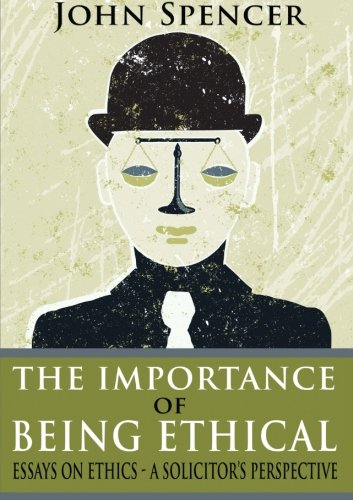
My first book, The Importance of Being Ethical, is now available.

I was prompted to put pen to paper because of what I've seen happening in the personal injury sector and society at large. My premise is a simple one: our society is rife with unethical conduct, and it occurs to the detriment of everyone.

In the personal injury arena, we've seen all manner of shoddy practices in recent years, from referral fees and backhanders to cynical insurer-driven spin to the effect that we are plagued by a 'compensation culture' (a palpable myth) and that whiplash, a painful and debilitating condition, doesn't exist. These things have exercised me but so too have wider societal problems.

The Importance of Being Ethical book coverFor example, as we sit down to watch - or avoid - the latest series of The Apprentice, can we really believe that its contestants and their greed-driven egos are a good thing? In sport, why do we continue to condone cheating, as if the player who 'takes one for the team' is a shining exemplar of how to behave? In politics, the Nolan Principles, which put a premium on selflessness in the interest of the public good, are too often AWOL, as is also the case when it comes to ethics in the worlds of big business, banking, the media and police conduct.

But for all that the latest outrage inevitably prompts calls for a new set of laws, we rarely need them. As is illustrated by the phone hacking scandal, a raft of perfectly sound laws exist to criminalise rogue journalists' behaviour; their lack of ethical scruple meant that they chose to ignore the law.

"Integrity has no need of rules", said the French writer Albert Camus. He is right. We don't need a barrage of extra red tape but we do need a re-commitment to behaving ethically.

I hope that The Importance of Being Ethical prompts, in some small way, a re-engagement with doing the right thing.


The Importance of Being Ethical by John Spencer is available on Amazon and Lulu.

Thursday, 6 March 2014

The Importance of Being Ethical - book to be published soon

What do we mean when we talk about 'ethical behaviour'?

The question looms large when we look at much of public life in recent years. Scandal after scandal has dominated the front pages, from phone hacking to MPs being less than transparent about their expenses, and each time a familiar refrain is sounded: what happened to the notion of behaving ethically?

My preoccupation with questions of ethics has led to me doing something I never thought I'd do - writing a book. It's called The Importance of Being Ethical, and it'll be published in a couple of months.

All is not what it seems

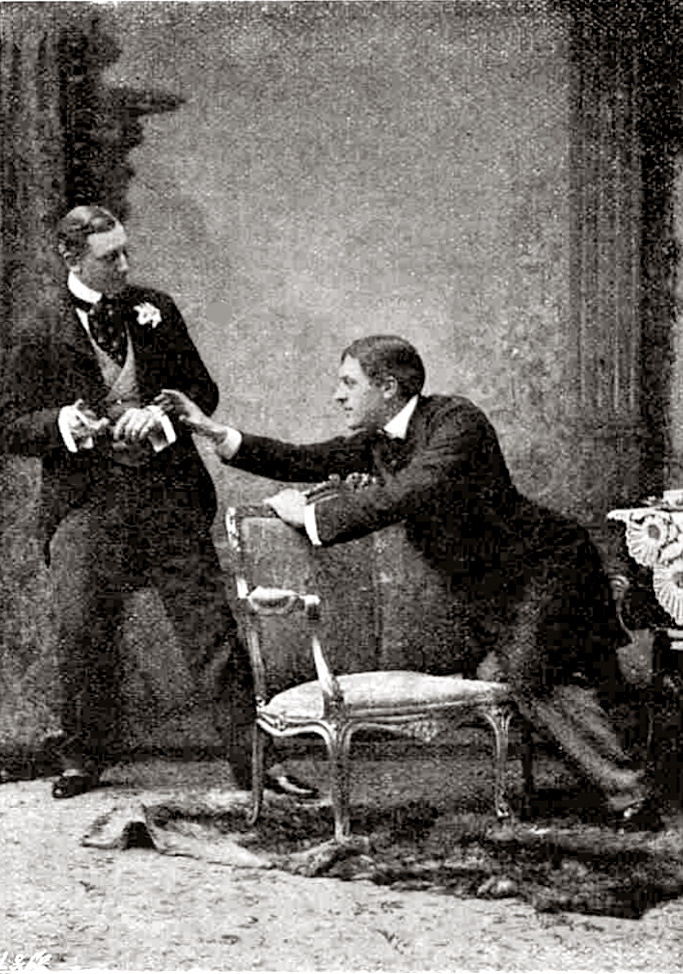
Photograph from Act 1 of the original production of The Importance of Being Earnest (1895)

The title is an allusion to the great Oscar Wilde play, The Importance of Being Earnest, which satirises Victorian notions of respectability and duty. To recap, the plot concerns of the love of Gwendolen Fairfax for Ernest - the alter ego of Jack Worthing, who was found in a handbag in the cloakroom of a London railway station by a Mr Thomas Cardew. Despite Jack's inauspicious start in life, he grows up among the landed gentry and is known as a pillar of the community in Hertfordshire, where he has a country estate. He finds his everyday life stultifying, and to escape it engineers a remarkable ruse: a disreputable brother called Ernest, his alter ego. He is always having to save Ernest from some calamity or other but Ernest, of course, does not exist.

Jack is a hypocrite, a man at ease with his deception. He wants to be perceived as upright and respectable, and has no qualms about his double identity. Gwendolen is no less preoccupied by the veneer of appearances. Obsessed with finding a husband whose name is Ernest - the name "inspires absolute confidence", says Gwendolen - she is unable to see through the deceit of Jack/Ernest.

The quality of being 'earnest' is uppermost in Wilde's mind. For him, being earnest meant inhabiting a world of false truths, smugness and complacency, a world in which so long as things appear to be alright, then they must be alright. Hence the play's most famous quote, uttered by the snobbish Lady Bracknell to Jack/Ernest: "To lose one parent, Mr Worthing, may be regarded as misfortune; to lose both looks like carelessness."

The play's denouement reveals that appearances are not to be relied upon; that to probe beneath the surface is to find a different story and, in fact, the truth.

Classic Wilde


The play is classic Wilde, in that his works are as paradoxical as they are amusing. As well as this, it seems to me to be as relevant today as it was when it was first performed over 100 years ago, on 14 February 1895 at St James's Theatre in London. Wilde still manages to shine a light on the hypocrisy which has come to permeate so many sectors of society.

So, in my book, I examine ethical dissonance in sport, popular entertainment, public service, the world of business, and, finally (by way of a topic particularly close to my heart), the personal injury sector. Time and again, in these arenas, it seems that appearances disguise a worrying, not say downright unpleasant reality. So long as everything seems to be OK, we ignore standards of professionalism and ethical rigour. But if we strip away the veneer, we find Jack Worthing, and Gwendolen Fairfax, to be alive and well.

The Importance of Being Ethical is a call to arms for those who believe in sound ethical principles and professionalism, in the concept of putting duty before profit, and for those who, like Jack Worthing, may prove to be Ernest after all. I hope that it will have resonance for anyone who cares about British public - especially those who believe that it is, after all, important to be ethical.

(And lastly, lest I set myself up for a charge of being less than transparent, the book has been co-written with a professional writer. More soon.)
Tuesday, 12 November 2013

Where have all the ethics gone? That the police need a code on ethics is a damning indictment of modern society

Yesterday's Times carried a short piece about the anger of those whose loved ones were caught up in the Hillsborough disaster towards Sir Bernard Hogan-Howe, the Metropolitan Police Commissioner.

Their anger stems from "confusion" over whether Sir Bernard - who, on the day of tragedy, was an officer at a club in Sheffield where families waited for news about fans - gave a statement to the Hillsborough inquiry carried out by Lord Taylor of Gosforth, the late Lord Chief Justice. Sir Bernard is on record as saying that he provided statements to Lord Taylor, but they do not appear in the archives of official documents published by last September's Hillsborough Independent Panel report.

Confusion all round


Sir Bernard now stands accused of making misleading statements about the inquiry into the tragedy. He himself says he was "confused" when he said that he had made a statement to Taylor inquiry.

Hillsborough's families would like the Independent Police Complaints Commission to investigate Sir Bernard's account and why he appears never to have made an official statement to the inquiry, despite having been an inspector in South Yorkshire police at the time of the disaster. The IPCC may well take up the baton; Sir Bernard says he will welcome any investigation they chose to undertake. For now, it would be wrong to prejudge what will come of this.

But if time will reveal the ramifications of the "confusion", the families' ire is understandable. It comes as an IPCC investigation into alleged police misconduct during and in the aftermath of Britain's worst sporting disaster continues. So much remains unresolved about police culpability at Hillsborough that fateful day; feelings cannot but run high.

All this might also explain paradoxical feelings about the Home Secretary's recent announcement that the police are to have their own code of ethics. The Times trailed this towards the end of October with a story headlined: "Officers must agree to 'respect and obey law'."

Ethics go for a bike ride

Draft Code of Ethics for policing in England and Wales
Those who gasped in astonishment at the notion that police officers were being asked to agree to respect and obey the law would only have grown more disconcerted by the story itself.

It transpired that in the wake of 'Plebgate' - the infamous incident involving the police, a politician, his bike and an unholy aftermath - the Home Secretary felt it necessary to issue the police with a new code of ethics. Its core message was exactly as per The Times' headline - that police officers would be reminded, via the code, of their duty to respect and obey the law. The College of Policing, itself a recent creation of Theresa May (who set it up in 2011 to professionalise the police force), had been tasked with drafting the code. The rationale saw professionalism invoked as the name of the game, with the College writing to its members (serving police officers) and saying it was "professionalising the service in the same way we see the General Medical Council's Standards and ethics guidance for doctors or The Bar Council's Code of Conduct of the Bar of England and Wales."

Professionalism is one thing. Having a police force that needs to be reminded of its duty to "respect and obey" the law is another. And yet to look at just three incidents in the past 25 years is to behold a police force that has a dubious relationship with its rationale.

The police are supposed to embody the rule of law. They're supposed to be peacekeepers, not law breakers. In living memory, they were also essentially benign characters, as helpful as they were authoritative. But we have seen poor behaviour by the police at Hillsborough and in its aftermath. We have seen racism – witness the death of Stephen Lawrence and the Macpherson Report. And now, after Plebgate, it transpires that nine out ten police officers believe the force must change.

Perhaps, then, we should be thankful to Theresa May and her innovative new ethical charter for the police. But we might ask what this says about our society. If our police need to be reminded to obey and respect the law, where have all the ethics gone?

Thursday, 22 August 2013

Taking a leaf out of Jesse Owens' book

Lately I've blogged about ethics in sport, not least because, to me, sport operates as a kind of mirror of our moral and ethical compass. Sportspeople are role models; their behaviour affects not just youngsters but adults, too. A society that condones institutionalised cheating in sport is likely to be one with ethical problems elsewhere. As such, we could all do with taking a leaf out of the great American track and field athlete Jesse Owens' book. I particularly like this quote by Owens, who won four gold medals in the 1936 Olympics:

In the end, it's the extra effort that separates a winner from second place. But winning takes a lot more than that, too. It starts with complete command of the fundamentals. Then it takes desire, determination, discipline, and self-sacrifice. And finally, it takes a great deal of love, fairness and respect for your fellow man. Put all these together, and even if you don’t win, how can you lose?

Jesse Owens in 1936

Saturday, 17 August 2013

In praise of ethics in sport

The football season seems to start earlier each year. I'm sure, when I was a boy, that games didn't start in early August, as they have for all of England’s professional and semi-professional leagues bar the Premier League. My memory might be playing tricks on me but one thing is certain: this weekend sees the beginning of another season of Premier League football.

Hot on the heels of an excellent, thoroughly enjoyable England v Scotland game on Wednesday, I'm hoping that this season's Premier League fixtures will be played in a similar spirit. On Wednesday night, the ancient football foes contested a hard-fought game with skill and passion in equal measure. There were one or two feisty moments, as is only to be expected in competitive fixtures, but what especially struck me about the game was the absence of any malice or cheating. I don't recall seeing any players diving to the turf as if felled by an axe; nor do I remember clusters of aggrieved individuals surrounding the referee and trying to intimidate him into giving a decision their way.

England v Scotland was a tough, dynamic game; it was football as it should be. On Sunday, I'll be watching my club, Chelsea, when they host newly promoted Hull City. Or rather, as they are now known, Hull City Tigers. Quite why the new name was required is beyond me; likewise, I don't understand why one of the other promoted teams, Cardiff City, elected to stop playing in their traditional all-blue strip and play in red.

Doubtless there is some marketing rationale for both changes. And lately, reading Rob Steen's excellent 1995 book The Mavericks: English Football When Flair Wore Flairs, I'm reminded of the era of greats like Peter Osgood, Alan Hudson, Charlie George, Stan Bowles and Rodney Marsh. The book brilliantly evokes their time as players, and is all the more intriguing with its accounts of how flair players dealt with the likes of Ron 'Chopper' Harris and Norman 'Bites Yer Legs' Hunter. Often enough, they gave as good as they got.

Football today is faster and more tactically complex than it was when the mavericks graced the pitches with their fancy footwork. But while the game has evolved, it has, in a sense, lost something. Rob Steen's book is a portrait of a more honest game than we see today. Players would try to gain an advantage by bending the rules, but somehow what they did strikes me as more ethical than the players of the modern game who feign injury and harangue officials. This sort of behaviour is doubtless a consequence of the vastly greater sums of money at stake in football now but there is no excuse for it. It demeans the game and those who play it.

Needless to say, I'll be hoping for a Chelsea win on Sunday. I also wish Hull City Tigers well in their new Premier League incarnation. But as much as I hope for Chelsea success, I hope that maybe, just maybe, this season we will have the privilege of watching games like England v Scotland: hard-fought, competitive and with no quarter given, but with a fundamental honesty. Ethics, in sport, are just as important as they are in other walks of life.

Friday, 19 July 2013

It’s just not cricket: Stuart Broad did the wrong thing in not giving himself out

The Ashes are underway and in their wake comes controversy. I refer to England batsman Stuart Broad having been caught at first slip last Friday afternoon, in what proved to be a close-fought England victory over Australia at Trent Bridge. I say 'caught', for that is what happened: Broad clearly nicked the Ashton Agar-delivered ball to Michael Clarke, who caught it from a deflection off Brad Haddin. Under the rules of cricket, Broad was out.

Except that the rules allowed the England player to keep quiet and await the umpire's decision. It came, and it turned out that umpire Aleem Dar hadn't seen the connection of bat and ball. And because Broad declined to walk - to give himself out - he was able to play on. His subsequent haul played a major part in what was ultimately an England victory.

Where have all the ethics gone?

Following the incident, cricket's great and good stepped in to defend Broad. To a man, they said he had done nothing wrong. He had simply played by the rules, doing the cricket equivalent of a footballer having committed an infringement of the laws of the game but waiting for the referee's whistle.

Take, for example, Ian Botham. "Stuart Broad did absolutely the right thing in standing his ground," said one of our nation's foremost cricketing role models. "He's got away with one," he added. "Good luck to him."

The former Glamorgan and England player, Steve James, described Broad's critics as "sanctimonious" while the batsman's father - who, coincidentally, is an International Cricket Council match referee - apparently sent his son a text telling him he had a future in acting.


Broad did the wrong thing

Forgive me for sounding a heretical note, but I think Stuart Broad did the wrong thing in not giving himself out. I imagine I might be called naive or even unpatriotic, especially if people have read my last couple of pieces on taking a leaf out of Australia's book. People are, of course, entitled to their opinion but I cannot but feel that something went wrong at Trent Bridge last Friday.

In so many spheres of life we encounter what I think we could call 'ethical dissonance'. Ethics are present in cricket; they underpin the laws of the game. And yet they're not wholeheartedly embraced. Because of this, ethics end up out of tune. They're dissonant.

It's not cricket, as the saying goes, and sadly it's a facet of sports from cycling to football to track and field and beyond. Look at Lance Armstrong: a man so divorced from standards of good ethical conduct that not only was he happy to take performance-enhancing drugs and deceive his legions of fans as well as cycling's authorities, he was even prepared to sue The Sunday Times for libel when it dared to expose him.

Look at football. From Diego Maradona's infamous 'hand of God' to the dubious hand of Luis Suarez in Liverpool's FA Cup third round tie against Mansfield last season, cheating is institutionalized. As in the case of Stuart Broad, every time cheating occurs the pundits are wheeled out to claim that the end justifies the means. Good luck to the player who conned the referee, say the 'experts'. Good luck, likewise, to the athlete Tyson Gay for saying he was clean for so long, and not getting caught until now.

Our sporting heroes should be role models, not cheats

Paolo Di Canio Fair Play
Are those who object to all this rightly described as "sanctimonious"? I have my doubts. Surely our sporting heroes are role models. What sort of message are they sending out to society and its youth if they condone cheating? It seems to me that they're saying, albeit unintentionally: "Don't worry about it; it's OK to cheat; just cross your fingers and hope no one notices".

This mentality underlines the misconduct of MPs on the make, with their noses in the trough, fiddling expenses and taking cash for questions. It explains why journalists thought nothing of phone hacking despite a raft of laws which criminalise it. It is the reason for the systemic flaws in the personal injury sector, where claimants are treated as statistics rather than people.

Stuart Broad should have walked. He should have done the right thing. He should have done a Paulo di Canio. In doing the right thing, he would not only have garnered massive respect from beyond the cricketing world. He would also have set the kind of example that we, as a society, ought to ask of those in positions of influence.

Friday, 21 June 2013

Lawyers need to be clear, open and ethical

On Monday the Law Society launches a new campaign. It focuses on the value of instructing a solicitor to provide sensible and accurate legal advice for personal injuries. Members of the public will be directed to advice on how to pursue a claim and, via the Law Society's Find A Solicitor search, they will also be shown how to find details of personal injury solicitors near them.

I welcome this campaign, not least because it promises to take "a bold, humorous and memorable approach" to convey an important message. Exactly what that approach is remains to be seen, but sources tell me that this is a non-aggressive and well-judged campaign.

Justice, not profit

It's also a timely one. Misinformation about the mythical 'compensation culture' continues to run deep, colouring the public attitude to all lawyers but especially those in the personal injury sector. In fact, far from being unscrupulous ambulance chasers (another regrettable and unfounded media cliché), the majority of personal injury lawyers are ethical individuals who come into this area of the law because they want to help the individual against what are often large and faceless conglomerates. The motivation is securing justice, not personal profit.

This is seen in personal injury cases from road traffic accidents to complex clinical negligence claims. Clients seek legal advice because they have been injured, through no fault of their own; it is the solicitor's duty and privilege to serve them and their families.

Unfortunately, as reported by the ever excellent Legal Futures website, on the eve of the campaign a law firm has been reprimanded for a radio ad which encouraged accident victims to claim compensation "irrespective of injury".

The Advertising Standards Authority (ASA) received a complaint regarding a radio ad by a firm called KL LLP, which trades as Secure Law. In the ad, listeners hear a woman telephoning a man, asking why he's late and if everything is OK. He replies: "Yeah fine, I just had a little bump in the car." He then says again that he is "fine" and asks for Secure Law's number.

I have not listened to the ad, but apparently the man repeats that he is "fine" for a third time, before a voice over states: "If you've been in an accident, make the second person you call Secure Law. They offer a no-win no-fee scheme, give you 100% of your claim and an upfront payment of up to £1,500."

An "irresponsible" radio ad

In its adjudication, the ASA said the firm argued that the ad "could not encourage someone to make a personal injury claim if they were not injured, because it would be censored by the Solicitors Regulation Authority, and would in all probability be put out of business, if not convicted in a court of law". The firm also evidently made much of the fact that the word "injury" wasn't mentioned in the ad.

The ASA rejected KL LLP's arguments. Upholding the complaint, it found that the statement "If you've been in an accident, make the second person you call Secure Law" encouraged listeners involved in road traffic accidents to contact Secure Law to claim accident compensation. The ad failed to make clear the basis on which the man had any grounds to make a claim and, concluded the ASA, was "irresponsible" because "the implicit message encouraged listeners to make a claim irrespective of injury."

The Law Society’s personal injury ad campaign, which will run for six weeks, will make use of radio ads for the first time; it is also planning to release a YouTube video.

Meanwhile, the campaign brings into focus a lesson that I believe all of us who work in personal injury law would do well to take to heart. We must remember is that if we want the public to believe in us - and to realise that a toxic blend of governmental and insurer-driven spin is what drives the misinformation about personal injury law - we lawyers need to be transparent at all times. We do a great deal of fantastic work for injured people, but in our communications there shouldn't be any room for doubt. If only we could be clear, open and ethical at all times, we might find that the media stigma of b'lame and claim' becomes a relic from an unlamented past.

Thursday, 6 June 2013

Ethically Correct

In the wake of the latest scandal to hit the government the need for a reinvigoration of sound ethical principles could not be more pressing.

It is, in fact, extraordinary that we are once again confronted with the dismal spectacle of MPs on the make. Nearly 20 years ago The Guardian exposed Britain's then best known parliamentary lobbyist, Ian Greer of Ian Greer Associates, for paying bribes to two Conservative MPs in exchange for asking questions in the House of Commons.

Cash for questions (again)

The 'cash for questions' affair, as it became known, led to understandable public outrage and to the Nolan Committee being set up by Prime Minister John Major.  Its task was to review the issue of standards in public life; in turn, it led to the creation of the Committee on Standards in Public Life.

Amid the collapse of high profile libel actions brought by Neil Hamilton and Ian Greer the Nolan Committee published its First Report, which articulated what it described as 'The Seven Principles of Public Life'. It is difficult to believe that each and every one of our current crop of MPs honours these principles, despite the fact that they are also enshrined in the Ministerial Code. By way of a reminder, here they are:

  • Selflessness - Holders of public office should act solely in terms of the public interest. They should not do so in order to gain financial or other benefits for themselves, their family or their friends.
  • Integrity - Holders of public office should not place themselves under any financial or other obligation to outside individuals or organisations that might seek to influence them in the performance of their official duties.
  • Objectivity - In carrying out public business, including making public appointments, awarding contracts, or recommending individuals for rewards and benefits, holders of public office should make choices on merit.
  • Accountability - Holders of public office are accountable for their decisions and actions to the public and must submit themselves to whatever scrutiny is appropriate to their office.
  • Openness - Holders of public office should be as open as possible about all the decisions and actions they take. They should give reasons for their decisions and restrict information only when the wider public interest clearly demands.
  • Honesty - Holders of public office have a duty to declare any private interests relating to their public duties and to take steps to resolve any conflicts arising in a way that protects the public interest.
  • Leadership - Holders of public office should promote and support these principles by leadership and example.

What was in Patrick Mercer's mind when he agreed to produce a Parliamentary report for a client for £2,000 a month? Evidently not the Seven Principles. Following a sting by The Telegraph and BBC's Panorama programme the MP for Newark has now resigned from the Conservative party and stated that he will not contest the next general election. One commentator said that in resigning Mercer had "acted honourably" but it strikes me that more honourable would have been not to have been tempted by financial gain in the first place.

The need for an ethical revolution 

Also embroiled in the scandal is Lord Laird, who has confirmed that he was approached by two BBC journalists posing for a fictitious consultancy group, which was supposed to be acting for the Fijian government. His Lordship says he has referred himself to the House of Lords standards watchdogs and to Black Rod, the House's senior official, and avows that he has not broken any rules.

This may well be the case. This story has some way to go yet, with Panorama airing at 9pm tonight. Doubtless the media will follow up tomorrow; Lord Laird may yet be exonerated - or he may face serious criticism.

But even if, in Lord Laird's case, rules were not broken, it seems to me that we cannot hope to avoid another case of egregious conduct by MPs if they insist on acting solely by reference to the rulebook. What must happen is that MPs, and all of us who serve the public, absorb the Seven Principles so that they become second nature. We must strive to act ethically at all times, so that even if, according to the rulebook, a course of action may seem acceptable, we may yet decide not to take it because it doesn't seem ethically correct.

This need for an ethical revolution is as prevalent in the professions as it is in politics. We can all make mistakes - to err is, after all, human - but if we managed to act according to the Nolan Committee's recommendations we might find that our mistakes aren't so frequent - and that they're not so costly.

Friday, 24 May 2013

Where did all the ethics go?

In September last year the Office of Fair Trading referred the UK's private motor insurance industry to the Competition Commission. The referral followed a study by the OFT in May 2012, which found that there were reasonable grounds to suspect that there are features of the insurance market that prevent, distort or restrict competition.

In other words: there is reason to think the insurance industry is not serving its customers well.

It's a year since the study that, in turn, led to the referral to the Competition Commission. Perhaps, if we look back at the study, we might find that insurers have started to get their house in order, ahead of the report of the Competition Commission in September next year?

Dubious Practices

Sadly, the short answer is 'no, they haven't'. The OFT, in its summary of the referral, put it thus: in focusing on "the provision of replacement vehicles and vehicle repairs", it was thought that "the insurers of drivers responsible for an accident ('at-fault' drivers) appear to have little control over the way repairs and replacement vehicles are provided to the 'not-at-fault' driver." The OFT  added that this "may enable the insurers of not-at-fault drivers, and others such as insurance brokers, credit hire organisations and repairers, to engage in practices which appear to result in the cost of replacement vehicles and vehicle repairs provided to not-at-fault drivers being higher than they might otherwise be."

What is meant by the use of the word "practices"? Let's be clear. This means the payment of referral fees. The Legal Aid, Sentencing  and Punishment of Offenders Act (LASPO) may have banned the flow of these between solicitors, claims management companies (CMCs) and insurers, but they are alive and as insidious as ever when it comes to garages, credit hire companies leasing vehicles to drivers after accidents and recovery companies.

A Conduit for Backhanders

If little, if anything, has really changed, there's worse. An (unintended?) consequence of the Alternative Business Structure (ABS) regime, which came into being in January 2012, is that insurers have a ready-made way of circumventing the referral fee ban: they can now simply buy or merge with law firms. The backhanders keep flowing.

It's not easy to discern in the terms of the OFT referral but there is clearly a huge question mark over the conduct of insurers and their representative body, the Association of British Insurers (ABI). The ABI has proved adept at spinning the yarn that 'compensation culture' fuels hikes in insurance premiums and makes our lives a hostage to unscrupulous bounty hunters who will issue a claim at the drop of a hat - and yet it is the ABI's very members who cause the 'blame and claim' syndrome in the first place.

These thoughts lead inevitably to a consideration of the ethical standards - or absence of them - at play among insurers. Time and again stories of outlandish litigation in the media turn out to be bogus or wildly exaggerated; time and again we encounter insurers blaming the increase in the cost of premiums on everyone but themselves.

In truth, investment income - which is what our premiums are used for - has flattened out because of the global recession and so insurers seek to ramp up their profits through a back door which has become nothing but a conduit for backhanders. It's a vicious cycle: as one insurer ups the ante, passing on costs to another, so does its competitor. And so on, and on - until, hopefully, the Competition Commission will do something about it.

Wishful thinking?

Meantime, as Duncan Minty's excellent blog recounts, insurers continue to fall short when it comes to acting ethically. This post, for example, reveals that a "survey by CSR Europe and KPMG of five European insurers and five European banks found that 80% had no ethical objectives or targets of any kind, while only another 10% had a qualitative target." As Minty notes, while admittedly a small survey it shows "that ethical objectives and targets remain a challenge for insurers."

From a claimant solicitor's perspective, I'm tempted to go further and say that acting ethically seems to resemble a brick wall for insurers. But bricks walls don't stand forever. Even the Berlin Wall came down eventually. Minty has produced a free e-Book on setting ethical objectives and targets for your business. Here's hoping that the CEOs of insurance companies download it, read it and learn from it. Wouldn't it be nice to think that they'll do so, ahead of the Competition Commission's report next year?

Wednesday, 23 January 2013

Refreshingly Boring - but Ethically Sound

It's rare, in today's world, to be heartened by anything to do with the banks but that is precisely how I feel thanks to last week’s story about Barclays' boss Antony Jenkins.

Jenkins has told the bank's 140,000 staff to buy in to its new code of conduct - or leave.

Leading by Example

Described by The Guardian as "a refreshingly boring banker", Jenkins has had his work cut out since his appointment at the end of August last year. He replaced Bob Diamond when the former CEO was forced out by the Libor fixing scandal. Barclays was fined £290m in June 2012 for its part in the scandal, and its troubles didn't end there. It is fair to say that Jenkins walked into a maelstrom, with a daunting task: to restore public confidence in an institution whose reputation has been absolutely shattered.

How to do this? Doubtless spin-doctors would come up with a variety of clever strategies, and it is just as certain that behind the scenes Jenkins would have been met with a bewildering array of tasks. But, for me, one thing was blatantly obvious: Jenkins needed to bring sound ethical principles back to Barclays. He needed to establish a professional ethos and set the tone and lead by example.

An Ethical Blueprint

Last week's announcement that bonuses and performance will now be assessed against a new 'purpose and values' blueprint goes some way to achieve this. Jenkins has not pulled his punches, and, in telling staff to sign up to five key values - respect, integrity, service, excellence and stewardship - he has positioned himself and Barclays firmly against the malpractice of the past.

Consider his words, as disseminated in a memo last Thursday:

"I have no doubt that the overwhelming majority of you … will enthusiastically support this move. But there might be some who don't feel they can fully buy into an approach which so squarely links performance to the upholding of our values. My message to those people is simple: Barclays is not the place for you. The rules have changed. You won't feel comfortable at Barclays and, to be frank, we won't feel comfortable with you as colleagues."

Jenkins' firm leadership is to be applauded. It is a stance that those in positions of power, whether in politics, the professions or elsewhere, would do well to emulate.